Pope Francis is awesome.
He can be terrifying to more traditionally minded Christians, frustrating to left-leaning Christians who want him to change the Church at the root, and often bewildering and exhilarating to the world. A lot of that is because he's a Jesuit, the very first Jesuit pope in the history of the Catholic Church.
What does that mean? Check out The Jesuit Guide to (Almost) Everything by Fr. James Martin, SJ, for a fair overview, and the talk by Fr. Robert Spitzer, SJ, delivered at Franciscan University of Steubenville, if you really want to understand.
But at the very root of it, to be Jesuit is to be a companion of Jesus. That's where the name comes from, after all--the name of the order was originally the Society (or the Company) of Jesus, modeled off of St. Ignatius of Loyola's experience of military companies, as well as the comradery and brotherly love of soldiers.
Now that doesn't just mean that a Jesuit or those formed by the Jesuits are supposed to be Christians. That's part of it.
No. See, here's the thing: If we do it properly, to love God is to love neighbor, and to love neighbor is to love God. Why? Because whatever we do to the least of our brethren, we do to Jesus. Jesus is present in those on the margins, those outside of respectable society and inside respectable society, the lonely rich and the desperately poor, the ordinary and the extraordinary, all. Why? Because He's the New Adam, the Man through whom divinity comes to share in humanity, and humanity in divinity. Through Him, the doorway to Heaven is open, and through Him, Heaven finds a path into the created order.
So to be Jesuit is to accompany Jesus in all His presences, all His ways of communicating His life and love, of showing His face of mercy to the world. To be Jesuit is to go out to the furthest reaches of the earth, to bring Jesus out to others and to meet Jesus in them, to discover the seeds of the Word in all cultures, all religions, and to know that we are meant to find Jesus shining through the created order, through every tree and river, every rock and star. We are to see the Logos' touch on every scrap of matter, see the image of Jesus in every human being, see God in all things.
Part of all that is the sort of self discipline, self mastery that you would expect of a soldier, because you can only practice absolute love if you can make an absolute gift, and an absolute gift is only possible if you have mastered yourself, if you are able to give everything to God.
That's what's going on with Pope Francis. He's calling the Church to leave the sheepfold to go after the one lost sheep, summoning the 99 sheep to follow the Good Shepherd on His quest for the wandering, the lost. Indeed, any number of the 99 may be far more lost than they think, even though they're in the sheepfold. The goal of the Christian life is to be with the God Shepherd, after all, not to live safely without Him, nor to sit smugly at home, secure in our own rightness, while there are lost sheep wandering far from home, exposed to the wolves and the weather.
So Pope Francis calls us to go out, to prioritize being with people, to prioritize loving people before preaching to them, to know them. He calls us to seek Jesus where He's at, whether that be in the confessional and the Eucharist, the Word of God and the Church, or that be in the poor, in the people outside the visible bounds of the Church, those far from home and those who know Jesus far better than we do, Catholic though we may be, church-going Christians though we may be. He calls on us to se the Creator in His creation, to find the seeds of the Word in the cultures and religions across the globe, to serve Jesus in those around us, in our neighbors and our enemies, in our respectable neighbors and disreputable neighbors alike.
Nowhere in all of that is the slightest suggestion of surrendering the teachings of the faith; rather, it's a call to trust that it's not up to us to make converts, or to make sure the Church maintains her teaching. Rather, it's a call to trust, a call to surrender to the Holy Spirit, the One who makes converts and is the life of the Church, the safeguard of her teaching. Oh, yes, we are to defend the Church, to explain her teaching, to discern truth and be wise as serpents and innocent as doves, yes. We are to fight the world, the flesh, and the devil, but we are to do it like Jesus did. We are to so love the world that we give ourselves for love of God and neighbor. We are to feast and to fast, to be all things to all people like Jesus did (hey, the Incarnation was the greatest example of inculturation we'll ever see!), and to so love our neighbors that they can see it and feel it, to walk beside them so that they come to know us, and to be so deeply steeped in the Holy Spirit that, coming to know us, they'll come to know Jesus, and find their way to share in eternal life.
Showing posts with label peace. Show all posts
Showing posts with label peace. Show all posts
Monday, May 1, 2017


Saturday, October 12, 2013
Happy Feast of Mary, Mother of the Church!
Pope Francis greets the original statue of Our Lady of Fatima in St. Peter's Square ahead of the consecration of the world to the Immaculate Heart of Mary tomorrow.
Here's a prayer by Pope Francis, prayed before the statue of Our Lady Aparecida in Brazil:
Here's a prayer by Pope Francis, prayed before the statue of Our Lady Aparecida in Brazil:
Mother Aparecida,
today I feel like you once did
before your God and mine,
who proposes for our lives a mission
whose contours and limits we ignore,
whose demands we only glimpse.
Yet in your faith that "nothing is impossible with God,"
O Mother,
you did not hesitate,
and so I cannot hesitate.
"Behold the handmaid of the Lord! Let it be done unto me according to your word!"
In this way, O Mother, like you,
I embrace my mission.
Into your hands I put my life
and we will
– you-mother and me-son –
we will walk together,
believe together,
fight together,
win together as your Son and you always walked together.
"Woman, behold your son! Son, behold your mother!"
Mother Aparecida,
You once took your Son to the Temple
to consecrate him to the Father,
that he might be fully available for the mission which awaited him.
Lift me up today to the same Father,
consecrate me to him,
all that I am and all that I have.
"Here I am! Send me!"
Mother Aparecida,
I put in your hands,
and so take to the Father, our and your youth, and World Youth Day:
so much strength, so much life,
so much dynamism sprouting and bursting,
which can be at service of life, of mankind.
"Father, welcome and sanctify your youth!"
Finally, O Mother, we ask you:
stay here,
always welcoming your son and daughter pilgrims,
but also come with us, be always by our side
and go along with us,
the great family of your devotees, in our own missions:
especially when the cross weighs heavy,
sustain our hope and our faith.
"Keep faithful, and I will give you the crown of life. Amen!"
Inconceivable! Hamas, Hezbollah Losing Legitimacy
Epochal, if true. Excerpts:
...Current discourse on Palestinian and Lebanese social networks indicates that a surprising trend has emerged over the past six months with potential momentous consequences for Israel’s security concept and the strategic challenges before it. The violent resistance (muqawama) against Israel by Hizbollah and Hamas has lost its legitimacy in Lebanese civil society and Palestinian society, respectively...In related stuff, see Pope Benedict XVI's document on the Church in the Middle East.
One of the most evident results of the “Arab Spring” has been the shift in focus by Arab civil societies from outside to inside – from foreign policy to domestic affairs. Civil society in the Arab world is demanding the redressing of injustices. Nationalism and Islamism have been replaced by a demand for democratization, rights, and freedom...
Tuesday, September 3, 2013
Syria, Peace, and Prayer
Elizabeth Scalia, as always, is awesome. Excerpts:
...When I read that we weren’t even looking at accurate images coming from Syria, I must admit to getting chills. We don’t know what’s real, anymore, and if the Secretary of State is using bad images, that’s bad enough; if he doesn’t even know he’s using them, that’s even worse, because it suggests a level of systemic incompetence that is terrifying to contemplate. It feels like no one actually has a good handle on any of our steering mechanisms, anywhere — like gyres are widening and centers are not holding. And what rough beast is slouching forward while our wheels are spinning?She ends with a call to prayer, reiterated by other sources.
But back to my original question: is the president being publicly goaded into attacking, by Assad? And if so, to what purpose? If “precise” US bombs are flying in Syria, does it give cover to Assad and “justify” a destructive responsive action? How big is this damned thing going to get? If we learned nothing from Iraq, we should have learned that strategies and tactics in the twenty-first century are not what they were in the twentieth; predictability has diminished, particularly in that region, and I’m not sure how many war historians and tacticians even get a full and thoughtful hearing in Obama’s very protective, very insulated, very politicized White House...
...Feel helpless in the face of so much violence and hatred around the world? Don't know how to respond to such information? There's no time for that! Those who love Mary have been given a special role to play in bringing peace to the world.And the Pope has spoken. Excerpts:
"At Fatima, Our Lady didn't ask us to go to Mass daily," said Fr. Dan. "She didn't ask us to make pilgrimages. She didn't ask us to read a lot of books. She asked us to do something that was easy and accessible to everyone — to children; to the educated; to the uneducated; each of us in our own way: to pray the Rosary for peace in the world."
Our Lady said to the three shepherd children at Fatima, Portugal, on July 13, 1917, "Continue to say the Rosary every day in honor of Our Lady of the Rosary, to obtain the peace of the world and the end of the war, because only she can obtain it."
She reiterated that call throughout her apparitions there, saying in May 1917, "Say the Rosary every day, to bring peace to the world and an end to the war [World War I]," and in September, "Continue the Rosary, my children. Say it every day that the war may end."...In these days when people are using chemical weapons against each other, Christians across the world are being savagely persecuted, and wars and rumors of wars abound every day, let all Marian Helpers live up to their name — help Mary bring peace to the world! Pray the rosary for peace in the world and spread devotion to Mary's Immaculate Heart...
...Speaking ahead of the traditional Angelus prayer with pilgrims gathered in St Peter’s Square this Sunday, Pope Francis said, “On [Saturday] the 7th of September, here [in St Peter’s Square], from 7 PM until midnight, we will gather together in prayer, in a spirit of penitence, to ask from God this great gift [of peace] for the beloved Syrian nation and for all the situations of conflict and violence in the world.” The Holy Father also invited non-Catholic Christians and non-Christian believers to participate in ways they feel are appropriate. “Never again war!” said Pope Francis. “We want a peaceful world,” he said, “we want to be men and women of peace...."
Tuesday, July 23, 2013
Infrastructure of Tyranny--Solutions
So, in light of this long list of unthinkable realities, what is to be done?
- Pray, especially the Rosary and the Chaplet of Divine Mercy. Pray for our politicians, our military and law enforcement personnel, our allies overseas, our enemies at home and abroad--everyone. Pray for their conversion and sanctification, the Holy Spirit in their hearts and minds, the transformation of the Indwelling Trinity for them now and into eternity. Pray! As grace is unleashed into the world by our inviting God in, more people will become holy. A civilization of love depends upon a society of saints--a whole generation of people who answer the universal call to holiness. That's how the culture of death and fear will be confounded and the culture of life will win out. We won't be able to discern light from darkness without prayer. Nor will our actions have supernatural power or our words be full of truth if we aren't regularly getting in touch with God, the way, the truth, and the life. Don;t forget to fast, as well!
- Accept the antique maxim "Give me liberty or give me death!" We must remember that if we surrender all our liberties for security, we shall have neither liberty nor security. Be willing that there should be casualties in a free society, or else we shall give all our rights away for no sure security.
- Know and love your neighbors. Join groups. Form networks of friends, acquaintances, relatives, that cannot be sundered if you lose your phone or are offline for a time. Get to know the people around you. Love them. Pray for them. Go to church, or temple, or mosque, or whatever house of worship you choose--but join. Join the Knights of Columbus, or the PTA, or a book club, or something, just to better know and love the people around you. Take local community and family seriously. They're the ones who'll be around for you when you're old or ill or in need. If you haven't built those relationships, you will truly be all alone with no attachments to anything larger than yourself should the bottom ever fall out of your life.
- Do works of mercy and don't stop. Find the needs which your time, talents, or treasure can best answer, then meet those needs.
- Get involved in local politics. It's the local politicians of today who, in a few years or decades, will be the national and international powerhouses. If you want to see good, honorable people in national politics, start encouraging good, honorable people to get involved in local politics. Get involved yourself! Stop complaining about the people on offer and get your name or the name of the best and wisest human beings you have ever known on the ballot.
- Join one of the major parties and stand your ground. There must be criticism from within. There must be pro-life Democrats and Republicans who refuse to accept "anything in the name of national security." There must be people who will not go with the flow, who will be living things and go against the current, to paraphrase Chesterton. Only then will the parties come to their senses.
- Speak the truth. Write letters to the editor. Write blogs. Post on Facebook. Don't go quietly into this looming night. Speak! If enough of us talk about these impossible, insane, unthinkable realities which are falling into place around us, then we will live in an educated electorate. There will be hope for real democratic change based upon a knowledge of the severity of the situation and, at the same time, a sense of empowerment to make a change. Remember the methods used by Vaclav Havel, Pope John Paul II, Solzhenitsyn, and others to fight the doublethink and the culture of the lie they faced. Take to heart the wisdom of George Orwell: “In a time of universal deceit - telling the truth is a revolutionary act.” The truth is powerful--always has been, always will be. "And then you will know the truth, and the truth will set you free." John 8:32.
- Be holy as your Father in heaven is holy. Here's
how, and here
, and here
, and here
.
Thursday, June 20, 2013
Catholics! Set Aside Your Despair! To Arms!
A to-do list for the new evangelization and answering the universal call to holiness. Excerpts:
...The Church does not exist for itself, but for the world, rather. And if its attention is on itself, Screwtape wins. The world now needs magnanimity, about which the Church, as proclaiming that which is more human and more dignified, is an expert. But this expertise must be taught, used, and just now what is needed is to show the glories of being human, always, of course, by revealing Christ who is the human made full, but also by the saints who have identified with Christ, and in the realm of human virtue and accomplishment and skill.
It’s to our tasks, I suggest, to our laboratories and workshops and studios, to the concert halls, lecture halls, surgeries—to our work, whatever it might be, in which we can give some indication of the greatness in whose image the human is and to which we are called and capable.
This is, admittedly, something of a tall order. The institutional Church lacks resources it once had, its reputation is diminished, dissent still hinders unity, and the significant contributions of individuals, whether lay or ecclesial, must attain a union of direction, purpose, and action. How is all this to be done, practically? Well, there is no formula, but neither are we without guidance.
First, work in Faith, grounding our hope in the foundation of Pentecost. On the first Good Friday, no one would have had good reason to think the small band of disciples—scattered, confused, splintering, some even unfaithful—would have amounted to much, and even after the Resurrection they lacked cohesion and public witness. But come Pentecost they are transformed, bold, clear, unafraid, and their work bears fruit. We can hope in the same, for the same Spirit lives and moves and breathes in us still—so, to our work, trusting that it is God who brings fruit, and will do so.
Second, distinguish fruit from leaves. Jesus draws near the fig tree, subsequently cursing it for its lack of fruit, because it was “in leaf” (Mk 11:13). Having all the trappings of fecundity, it lacked substance. We can expect, I think, many of our leaves to drop—grand buildings, parish schools, cultural acceptance and prestige, these may not be ours for long—but Christ promises none of those things, but instead His own presence, the Spirit as guide and comforter, the persistence of the Church, and a final victory. So, we seek fruit, holding leaves—which are, after all, delightful things—somewhat loosely.
Third, respect freedom. One reason I entered the Church was catholicity, namely, that it had not splintered but remained one, even though the various charisms, forms of spirituality, religious orders, and tastes were staggeringly diverse. A Church that includes Jesuits and Carthusians, Francis and Aquinas, Palestrina and Suzanne Toolan, knows, or should know, how to respect freedom in those things which are not defined or required so as to move in unity on the essentials. We cannot lose ourselves in little inner battles, when a watching world can’t tell the distinctions apart anyway, but looks to see if we profess the truth and live in love.
Fourth, appropriate what is there. The resources of the tradition are virtually overwhelming. Like so many converts from evangelical Protestantism, I took the first steps to Rome because of the sheer enormity and breadth of the received wisdom. We have the Fathers, the scholastics, the saints, the mystics, the martyrs, Scripture, art, music, poetry, cathedrals, monasteries, religious orders, doctors, theologians, encyclicals, we have the Catechism—there is no shortage of essential resources, if only we would turn to them. So, we need to learn these things, perhaps taking a lesson from Orthodox Jewish models of study in which many men and women of action and business nonetheless are students and scholars. Of course we work to make RCIA robust, school theology courses vigorous, the seminaries and pastors learned, the colleges more Catholic; but in the meantime, we can, all of us, read Augustine and learn to sing.
Fifth, celebrate. It’s very easy to become lost in our losses, and to forget that the Church is growing worldwide, that the Bishops are exercising moral leadership on matters of religious freedom, that men like George and Chaput and Scola (to name just a few of the many) exist, that new publishing houses and online journals spring up, that Francis leads and we still have Ratzinger writing, that many Protestants are discovering the fullness of Faith, and on and on it goes.
Sixth, rest in communion. The saints intercede for us, as does Our Lady, and we are surrounded by an enormous cloud of witnesses—those alive in body and those alive in soul only—praying and working, all. The sacrifice is performed and received now and in eternity, and God has taken residence with us. Be not afraid, we have all we need.
Seventh, learn shrewdness and innocence. Disposition alone solves nothing, we must also deliberate wisely and lengthily, guided by prayer, the tradition, authority, and reason, about what to do. We must be shrewd and watchful “in prayer and in love,” and we must cultivate those traits in the whole community of the faithful. The time of naivety is long past, the time of riding cultural heritage has departed, and we must be without guile, but also without stupidity...
Friday, May 17, 2013
Peter Kreeft, Prayer, and Patience and Perseverance
Yeeps. My problems exactly, all in one paragraph. Excerpts
Patience and perseverance are two aspects of the same virtue, which is fidelity, or faithfulness. We sometimes mistakenly think of patience and perseverance as opposites because we think of patience as resignation and perseverance as stubbornness – as if patience were almost despair and perseverance were almost pride. In the same way, we mistakenly think of holy humility and holy ambition as opposites, when in fact they are two complementary aspects of the Godlike soul. God is both humble and ambitious, “easy to please but hard to satisfy”. He is simultaneously patient and persevering, gentle and persistent, like water wearing away rock. The strongest forces in the universe , both physical and spiritual, always have that Godlike Character. It is only because our minds are fallen and broken in two that we break this character in two and use two contrasting words for it.--Peter Kreeft, Prayer for Beginners, (Ignatius, 2000), pg. 121
Wednesday, February 27, 2013
Pope Emeritus, "Two Popes," And Facepalm
This is what happens when a media without a substantial understanding of Catholicism starts trying to do some serious reporting on the Church--they keep on trying to force an institution with its roots in the eternal communion of the Trinity into the flat, horizonless secular perspective dominant in the West which sees all power emanating from money, sex, and political power. Which then leads to serious chin-pulling speculation about the inevitable future difficulties of a pope emeritus walking the earth while a present pontiff serves as the rock. Cause, well, you know...
 Okay, so why is this such a bad bit of commentary? First of all, because the quote as included from Mr. Walsh makes it sound like the Vatican has announced that the Pope intends to be gadding about, peeking in now and then, just to give a little input, nothing too overbearing...like some Dowager Pope of Vatican City. Someone here is totally missing what's actually being said.
Hint: Catholicism does not accept that the only way to influence world events is by the use of power (political influence) or wealth (economic influence) or even worldly culture (even though that last was one of Blessed Pope John Paul II's greatest tools). What's this strange source of Catholic power that the Pope intends to use in order to have influence on the Church and the world? Gee! What on earth could it be? I mean, it's not as though he's indicated what that power was in his last statements these past few weeks.
Come, Anchoress! Make things well again! Excerpts:
All right, I suppose I can't blame them entirely. Some blame has to go to Catholic commentators such as Mr. Michael Walsh. Mr. Walsh--really? Really? Excerpts:
...Catholic author Michael Walsh told CNN he was unsurprised by Benedict's desire for more privacy.
"He's a rather private man. He wants to get back to his books and his cats, he wants to get back to prayer," he said. "He's obviously coming towards the end of his life -- he's 85 -- so I understand that."
But, Walsh added, "what I don't understand is that he says he wants to be part of it all, which could be disastrous if you take it at face value," referring to Benedict's promise not to abandon the church.
"The notion that you have two people that claim to be pope, in a sense, is really going to be very confusing," Walsh said.
Vatican officials have said they don't anticipate any interference from Benedict as a new pope takes office.
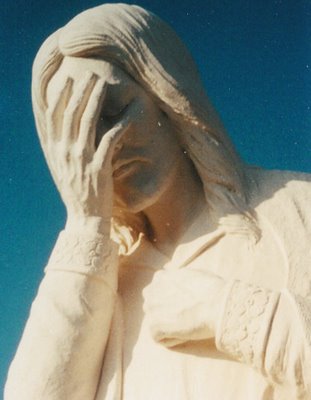
Hint: Catholicism does not accept that the only way to influence world events is by the use of power (political influence) or wealth (economic influence) or even worldly culture (even though that last was one of Blessed Pope John Paul II's greatest tools). What's this strange source of Catholic power that the Pope intends to use in order to have influence on the Church and the world? Gee! What on earth could it be? I mean, it's not as though he's indicated what that power was in his last statements these past few weeks.
Come, Anchoress! Make things well again! Excerpts:
...You might call it a supernatural gambit (and it wouldn’t be Benedict’s first) as in one move Benedict is both teaching by example and subverting the world in a way perhaps only the evil one understands; the prayers and penances of a Vicar of Christ, unimpeded by the trappings and distractions of an office, will be powerfully efficacious.And the Cardinal Secretary of State has made public a letter to the contemplative communities of the world in the last few days. It reads in part:
Those who think Benedict has simply lain down his staff do not understand that he lays it down to pick up a flamethrower of sorts. For however long he lives as a monastic, he will be a conduit of prayer, praise, adoration and supplication for the rest of the world. He is taking on huge duty.
In faith he will have delivered the powerful lesson that a life of faith is never without resources, because prayer extends beyond time and space, through darkness and into light....We’ve never seen this before in our lifetimes; it’s remarkable to ponder that the pope, along with monastics around the world, will be so very focused on the selection of the next pope.
And perhaps we will need to learn that lesson well, to face our future, together...
A monastery is a kind of powerhouse of prayer, but with distractions and impediments removed from its functioning; in enclosure, Benedict will become “a house of prayer and a temple of intercession” for us all. His hope and ours may reside, as it has before, in the simple yet profound reach of a monk.
...His Holiness Benedict XVI has asked all the faithful to accompany him with their prayers as he commends the Petrine ministry into the Lord’s hands, and to await with trust the arrival of the new Pope. In a particularly urgent way this appeal is addressed to those chosen members of the Church who are contemplatives. The Holy Father is certain that you, in your monasteries and convents throughout the world, will provide the precious resource of that prayerful faith which down the centuries has accompanied and sustained the Church along her pilgrim path. The coming conclave will thus depend in a special way on the transparent purity of your prayer and worship.This confusion on the part of some authors and the media is rather like the section in Carl Bernstein and Marco Politi's His Holiness about Pope John Paul II. There was one section in the book where they give a run down of all his great work, his many accomplishments, and wonder how on earth he does it all. Then a few paragraphs later, in a very casual, throwaway line sort of way, they mention how much he prayed. As though the two had nothing to do with each other.
The most significant example of this spiritual elevation which manifests the most authentic and profound dimension of every ecclesial action, the presence of the Holy Spirit who guides the Church, is offered to us by His Holiness Benedict XVI who, after having steered the barque of Peter amid the waves of history, has chosen to devote himself above all to prayer, contemplation and reflection...
Thursday, February 14, 2013
Deus Caritas Est and Caritas in Veritate: Pope Benedict XVI's Social Teaching
Even though the Compendium of the Social Doctrine of the Church is awesome, it was released before Pope Benedict XVI's papal contributions to the Church's social teaching were published. So, to round out the series, here's the USCCB's recounting of those contributions:
...Deus Caritas Est (God is Love) 2005, Pope Benedict XVI -- Benedict's first encyclical, that could have been an abstract or scholarly treatise, instead dug deep into the concept of love and cited the connections between love of God and love of neighbor. Pope Benedict said the Church could no more neglect charity than it could Scripture or the sacraments and even called charity a manifestation of Trinitarian love.Their summary came before the release of Caritas in Veritate. Here's a more detailed summary. Excerpts:
Caritas In Veritate (Charity in Truth) 2009, Pope Benedict XVI -- anticipated since 2007, this encyclical is believed to follow up on the themes of Populorum Progressio. Dealing with the ethics of contemporary economics, it's reasonable to think that the global economic crisis will weigh in heavily on what the pope has to say.
Caritas in Veritate, Pope Benedict's third encyclical, is a call to see the relationship between human and environmental ecologies and to link charity and truth in the pursuit of justice, the common good, and authentic human development. In doing so, the pope points out the responsibilities and limitations of government and the private market, challenges traditional ideologies of right and left, and calls all men and women to think and act anew...
Monday, February 11, 2013
Populorum Progressio and Octogesima Adveniens: Pope Paul VI on Economic Development and Post-Industrial Society
From the invaluable Compendium of the Social Doctrine of the Church. Excerpts:
...“Development is the new name for peace”[180], Pope Paul VI solemnly proclaims in his Encyclical Populorum Progressio[181], which may be considered a development of the chapter on economic and social life in Gaudium et Spes, even while it introduces some significant new elements. In particular, it presents the outlines of an integral development of man and of a development in solidarity with all humanity: “These two topics are to be considered the axes around which the Encyclical is structured. In wishing to convince its receivers of the urgent need for action in solidarity, the Pope presents development as ‘the transition from less humane conditions to those which are more humane' and indicates its characteristics”[182]. This transition is not limited to merely economic or technological dimensions, but implies for each person the acquisition of culture, the respect of the dignity of others, the acknowledgment of “the highest good, the recognition of God Himself, the author and end of these blessings”[183]. Development that benefits everyone responds to the demands of justice on a global scale that guarantees worldwide peace and makes it possible to achieve a “complete humanism” [184] guided by spiritual values.
In this regard, in 1967, Pope Paul VI establishes the Pontifical Commission “Iustitia et Pax”, thus fulfilling the wishes of the Council Fathers who considered it “most opportune that an organism of the Universal Church be set up in order that both the justice and love of Christ toward the poor might be developed everywhere. The role of such an organism would be to stimulate the Catholic community to promote progress in needy regions and international social justice”[185]. By initiative of Pope Paul VI, beginning in 1968, the Church celebrates the first day of the year as the World Day of Peace. This same Pontiff started the tradition of writing annual Messages that deal with the theme chosen for each World Day of Peace. These Messages expand and enrich the corpus of the Church's social doctrine.
At the beginning of the 1970s, in a climate of turbulence and strong ideological controversy, Pope Paul VI returns to the social teaching of Pope Leo XIII and updates it, on the occasion of the eightieth anniversary of Rerum Novarum, with his Apostolic Letter Octogesima Adveniens[186]. The Pope reflects on post-industrial society with all of its complex problems, noting the inadequacy of ideologies in responding to these challenges: urbanization, the condition of young people, the condition of women, unemployment, discrimination, emigration, population growth, the influence of the means of social communications, the ecological problem...(articles 98-100)
Sunday, February 10, 2013
Mater et Magistra & Pacem in Terris: Peace on Earth and Good Will Towards Men
From the invaluable Compendium of the Social Doctrine of the Church. Excerpts:
...Blessed Pope John XXIII, in his Encyclical Mater et Magistra[164], “aims at up-dating the already known documents, and at taking a further step forward in the process of involving the whole Christian community”[165]. The key words in the Encyclical are community and socialization[166]: the Church is called in truth, justice and love to cooperate in building with all men and women an authentic communion. In this way economic growth will not be limited to satisfying men's needs, but it will also promote their dignity.
With the Encyclical Pacem in Terris[167], Blessed Pope John XXIII brings to the forefront the problem of peace in an era marked by nuclear proliferation. Moreover, Pacem in Terris contains one of the first in-depth reflections on rights on the part of the Church; it is the Encyclical of peace and human dignity. It continues and completes the discussion presented in Mater et Magistra, and, continuing in the direction indicated by Pope Leo XIII, it emphasizes the importance of the cooperation of all men and women. It is the first time that a Church document is addressed also to “all men of good will”[168], who are called to a great task: “to establish with truth, justice, love and freedom new methods of relationships in human society”[169]. Pacem in Terris dwells on the public authority of the world community, called to “tackle and solve problems of an economic, social, political or cultural character which are posed by the universal common good”[170]. On the tenth anniversary of Pacem in Terris, Cardinal Maurice Roy, the President of the Pontifical Commission for Justice and Peace, sent Pope Paul VI a letter together with a document with a series of reflections on the different possibilities afforded by the teaching contained in Pope John XXIII's Encyclical for shedding light on the new problems connected with the promotion of peace[171]...(articles 94-95)
Sunday, February 3, 2013
To Love Another Person Is To See The Face of God
Yes, love; love changes everything. From the Compendium of the Social Doctrine of the Catholic Church:
...The transformation of the world is a fundamental requirement of our time also. To this need the Church's social Magisterium intends to offer the responses called for by the signs of the times, pointing above all to the mutual love between human beings, in the sight of God, as the most powerful instrument of change, on the personal and social levels. Mutual love, in fact, sharing in the infinite love of God, is humanity's authentic purpose, both historical and transcendent. Therefore, “earthly progress must be carefully distinguished from the growth of Christ's kingdom. Nevertheless, to the extent that the former can contribute to the better ordering of human society, it is of vital concern to the kingdom of God”[67]...(article 55)
Saturday, February 2, 2013
The Essence of Social Justice
Dang, the Compendium of the Social Doctrine of the Church is well done. Get a copy and read it in this Year of Faith. They begin with the roots of human dignity in the beginning and the Trinity, then descend from there to the issues of social justice today and forever. Really, really good stuff. This is probably the first of a bunch of excerpts:
...The inner transformation of the human person, in his being progressively conformed to Christ, is the necessary prerequisite for a real transformation of his relationships with others. “It is necessary, then, to appeal to the spiritual and moral capacities of the human person and to the permanent need for his inner conversion, so as to obtain social changes that will really serve him. The acknowledged priority of the conversion of heart in no way eliminates but on the contrary imposes the obligation of bringing the appropriate remedies to institutions and living conditions when they are an inducement to sin, so that they conform to the norms of justice and advance the good rather than hinder it”[43].
It is not possible to love one's neighbour as oneself and to persevere in this conduct without the firm and constant determination to work for the good of all people and of each person, because we are all really responsible for everyone[44]. According to the Council's teaching, “they also have a claim on our respect and charity that think and act differently from us in social, political and religious matters. In fact the more deeply we come to understand their ways of thinking through kindness and love, the more easily will we be able to enter into dialogue with them”[45]. This path requires grace, which God offers to man in order to help him to overcome failings, to snatch him from the spiral of lies and violence, to sustain him and prompt him to restore with an ever new and ready spirit the network of authentic and honest relationships with his fellow men[46]...(articles 42-43)
Friday, January 25, 2013
The Meaning of Life is Love
As proven by the fact that no one is born alone, no one dies alone (thanks to the communion of saints, the omnipresence of God, and your guardian angel), and the path to deepest satisfaction, joy, and peace is through agape love.
Wednesday, January 9, 2013
A Defense of Michael O'Brien
"It's probably not a great work of literature. But he poured his heart into it. It's about the search for beauty and for love in a fallen world."I was reading around Mark Shea's blog and stumbled across a spate of Michael O'Brien
"A well-examined theme in literature."
"The favorite of serious writers."
"One might even say, the favorite theme of the human heart."
"I suppose that's true."--Michael O'Brien, Father Elijah, pg. 347.
 bashing in the comments on this post.
I have to put in a word of defense for O’Brien here. While I agree that his formal style can be off-putting and his writing is not the best, I would argue that he does far, far more good than harm. There are depths to his books which the Left Behind series never begins to dream exist, let alone expose. He manages sympathetic portrayals of people who have fallen very far and very hard–for all that he tends to be rather black and white about things (see the whole Harry Potter brouhaha), in his novels, at least, you have some very sympathetic portrayals of gay characters (Smokrev; Pawel Tarnowski), of atheists and agnostics (Ann Delaney), of even architects of the reign of evil (Maurice L’Oraison). The characters are given reasons for the wrong they do that transcend the simplistic style of LaHaye and Jenkins by far, and actually ground and round out the characters in a manner far beyond the sort of awfulness I hear people accuse him of perpetrating.
O’Brien writes icons, both with paint and with his pen. The books are the product of fairly substantial prayer, I think, and reflection, as well as study. Are they great literature? No. Are they good books? I think so. Are they capable of saving souls and turning lives around? Yes, and I’ve seen them do it. Do they answer a substantial need in our time? Yes. For all that they may be obvious to the experienced practicing Catholic, they came as a great light to me when I was in college and trying to figure out what the heck had happened to the Jesuit universities. He does a great exposure of the illnesses of modernity, answering some of the deepest questions asked by contemporary man, and does it well. He gives answers many people will never have heard before in a readable context. Don’t discount what a great contribution that is. Until we have better Catholic fiction writers working in the world today, O’Brien fills a major void, and I think his work has the potential to endure because it’s so thoroughly grounded in eternal things, telling archetypal stories.
I agree that he intends to be a culture warrior–I think, given some of his life experiences, it’s more understandable than in many others. His adamantly militant stance on some issues make him tone-deaf occasionally (the whole Harry Potter affair), but he also conveys a great deal of the richness of the faith in his books.
I don’t know nearly enough about icons and so forth to judge his art, but I think his method is the same–praying, writing, with a greater concern for fidelity to the truth and the light given than perhaps for the highest standards of literature and art. He’s contributing a great deal more to the Church and the world than he’s being given credit for in many of these comments. Is he as good a writer as Walter Miller
, John Wright, Michael Flynn, or the others listed here? Probably not. But I think his work will last because his books reflect the reality of the struggle within the Church right now.He has accurately and sympathetically held up a mirror to certain great problems in the modern age. He has listened to the teachings of John Paul II, among many others, and translated them into readable, workmanlike stories (even if he’s not a great writer). Christ calls us to do good work–I think O’Brien has done good work.
Not all Christian literature needs to be at the level of the Divine Comedy, the work of Sigrid Undset
, Harry Potter , or The Lord of the Rings
 . There has always been and always will be the kitschy and the clumsy. All of it is part of the rich texture of a living culture. We need great art, yes. But of course, there has been and will continue to be merely good art, merely decent art, serviceable art, and bad art. And I think there’s a place for most of that.
I would argue that O'Brien, overall, crafts good art, with moments and intersections of his Children of the Last Days cycle touching the level great art. He manages to make his work transparent to God, permitting the reader to see the world through the eyes of Christ and Christ's Church at key points. His formalism doesn't always sit well with me--I think there are times when he's writing too deeply in the tradition of the Russian novelists, inheriting too great a touch of the stylized from Eastern European sensibilities. But again--I think he does good, necessary, valuable work.
He made as if to go back down the mountain, but stopped and looked back at the statue. A pathetic, lifeless madonna, devoid of artistic sense, and yet a symbol through which the Mother had come. It was her way, of course, for she had been a small poor maiden of Nazareth. Images of her were crowned in cathedrals throughout the world, icons painted by saints and statues carved by geniuses. She was loved and glorified through these mighty works, and through them she drew souls to glorify her Son, the One to whom she always and everywhere pointed. And yet she did not spurn the lowliest images, for they too were sign lifted up in the darkness of history, without false glory or human pride of accomplishment, words made from the clay of the earth and painted with pigments wrung from the earth by gnarled hands that toiled in the earth and hoped for paradise.--Michael O'Brien, Father Elijah, pg. 483
If you'd like to explore O'Brien's work, I'd recommend starting with Father Elijah: An Apocalypse
 . If you'd like a meditation on doubt, spiritual darkness, and a life without faith, pick up Strangers and Sojourners (Children of the Last Days) (v. 1)
 . If you want to watch the life of a saint unfold before you, pick up A Cry of Stone
 .
Tuesday, January 8, 2013
God Loves You as You Are--So Change!
If I speak in human and angelic tongues but do not have love, I am a resounding gong or a clashing cymbal. And if I have the gift of prophecy and comprehend all mysteries and all knowledge; if I have all faith so as to move mountains but do not have love, I am nothing. If I give away everything I own, and if I hand my body over so that I may boast but do not have love, I gain nothing.People often say, "Love me for who I am." "Accept me for who I am." "If you really loved me, you would love me for who I am and not ask me to change."
Love is patient, love is kind. It is not jealous, [love] is not pompous, it is not inflated, it is not rude, it does not seek its own interests, it is not quick-tempered, it does not brood over injury, it does not rejoice over wrongdoing but rejoices with the truth. It bears all things, believes all things, hopes all things, endures all things.
Love never fails.--1 Corinthians 14:1-8
And there's an element of truth in this expectation.
For Christ, while we were still helpless, yet died at the appointed time for the ungodly. Indeed, only with difficulty does one die for a just person, though perhaps for a good person one might even find courage to die. But God proves his love for us in that while we were still sinners Christ died for us.--Romans 5:6-8God loves us as we are, where we are, no matter what we've done or are doing or will do. God loves us. God is love. (1 John 4:8)
In this is love: not that we have loved God, but that he loved us and sent his Son as expiation for our sins. Beloved, if God so loved us, we also must love one another.--1 John 4:10-11
And yet--and yet! God loves us as we are, and calls us to become radically transformed because of his love.
“You have heard that it was said, ‘You shall love your neighbor and hate your enemy.’ But I say to you, love your enemies, and pray for those who persecute you, that you may be children of your heavenly Father, for he makes his sun rise on the bad and the good, and causes rain to fall on the just and the unjust. For if you love those who love you, what recompense will you have? Do not the tax collectors do the same? And if you greet your brothers only, what is unusual about that? Do not the pagans do the same? So be perfect, just as your heavenly Father is perfect."--Matthew 5:43-48Or, as Andrew Lloyd Weber puts it:
God's love--all love--is transformative.
To love is to contemplate, to be transformed.
And true, self-donating, self-emptying love always confounds evil.
So love reaches us where we are, enfolding us, suffusing us, holding us in life. And then it lifts us up where we belong.
To love at all is to be vulnerable. Love anything, and your heart will certainly be wrung and possibly broken. If you want to make sure of keeping it intact, you must give your heart to no one, not even to an animal. Wrap it carefully round with hobbies and little luxuries; avoid all entanglements; lock it up safe in the casket or coffin of your selfishness. But in that casket- safe, dark, motionless, airless--it will change. It will not be broken; it will become unbreakable, impenetrable, irredeemable.”--C. S. Lewis, The Four LovesAnd when we, by God's grace, take the risk of loving God, ourselves, and our neighbor, what happens then? Deification. (For more, see here.)
Thursday, January 3, 2013
Deification, Full of Grace, and How to be Happy
Man, I'm so far away from this state. Excerpts:
...For when the soul is thoroughly cleansed from all its corrupt affections, and is united, by an ineffable communion, to the Spirit, the Comforter, and is thoroughly mixed with the Spirit, and is become spirit itself, then is it all light, all eye, all spirit, all joy, all rest, all gladness, all love, all heart, all goodness and clemency...
Tuesday, December 25, 2012
God is With Us!
Merry Christmas!
Joseph, being of David’s clan and family, came up from the town of Nazareth, in Galilee, to David’s city in Judaea, the city called Bethlehem, to give in his name there. With him was his espoused wife Mary, who was then in her pregnancy; and it was while they were still there that the time came for her delivery. She brought forth a son, her first-born, whom she wrapped in his swaddling-clothes, and laid in a manger, because there was no room for them in the inn.
In the same country there were shepherds awake in the fields, keeping night-watches over their flocks. And all at once an angel of the Lord came and stood by them, and the glory of the Lord shone about them, so that they were overcome with fear. But the angel said to them, Do not be afraid; behold, I bring you good news of a great rejoicing for the whole people. This day, in the city of David, a Saviour has been born for you, the Lord Christ himself. This is the sign by which you are to know him; you will find a child still in swaddling-clothes, lying in a manger. Then, on a sudden, a multitude of the heavenly army appeared to them at the angel’s side, giving praise to God, and saying, Glory to God in high heaven, and peace on earth to men that are God’s friends.--Luke 2:4-14
And the Word was made flesh, and came to dwell among us; and we had sight of his glory, glory such as belongs to the Father’s only-begotten Son, full of grace and truth.--John 1
The soloist from the above clip is in the movie version of Les Miserables which comes out today, a fantastic tale of grace and redemption.
Saturday, July 7, 2012
Beauty in the Church
Absolutely necessary. Excerpts:
...One of my cousins is a Capuchin priest. He has worked very closely with the very poor and disadvantaged for decades, and he bristles when people talk about “frivolous beauty” or “liturgical pomp”, and when they declare that beautiful things should be stripped down and sold for the poor. “You help the poor by being with them, living and working with them; being one with them, because one of the biggest needs of the poor is the reception of a simple message: ‘You’re as important as anyone; you are loved and loveable.’ You don’t send that message by making the world uglier for them.”
Sell everything in a church, strip it down and you buy some temporary assistance; then the people who sold all that sinful, frivolous beauty go back home, feeling pretty good about themselves and all the ‘help’ they gave to ‘the poor.’ But when the money runs out — and my cousin says money running out is one of the few things you can bank on — then for the poor who remain, “it’s back to business as usual, but with nothing beautiful for them, anywhere.”...
...In no other aspect of our lives do we demand a reason for beauty or question its purpose. We accept and appreciate beautiful art, music, or a sunset for what it is and allow it to uplift us. For some reason beauty is not suspect except when found in the Church. Then it becomes a waste of money, gaudy excess, and idolatry. Suddenly we are expected to ban beauty in His own house when He Himself made us with this desire to create and appreciate beauty? How odd.
Saturday, April 14, 2012
Archbishop Tutu and Gonzaga's Commencement Exercises
The controversy over Archbishop Tutu at Gonzaga has come up several times recently in conversation with friends and family, so I figured I'd post this here.
First off, of course, he's a tremendous figure on the world stage, and I am a relatively innocuous blogger, so there's a certain temerity in commenting in the first place. But I think there's a reason for this controversy.
First off, of course, he's a tremendous figure on the world stage, and I am a relatively innocuous blogger, so there's a certain temerity in commenting in the first place. But I think there's a reason for this controversy.
Subscribe to:
Posts (Atom)
LinkWithin
